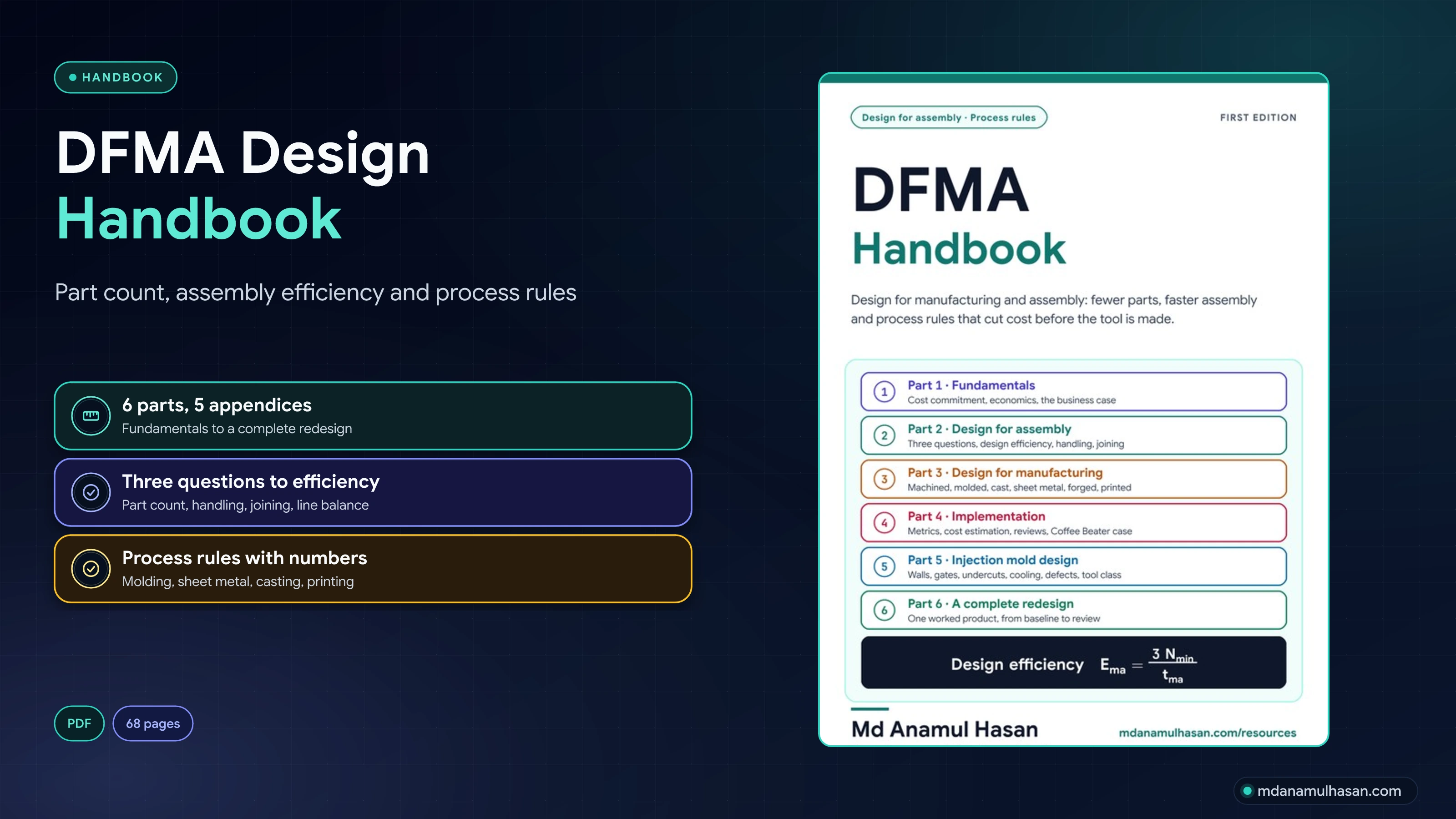
DFMA Design Handbook: Part Count Reduction, Assembly Efficiency, and Process Rules
A 68-page handbook for design for manufacturing and assembly: the three part-count questions, design efficiency, handling and insertion, joining and line balance, process rules for machining, molding, casting, sheet metal, welding, forging, extrusion and printing, tolerance stack-up, process choice by volume, injection mold design in depth and a complete redesign. PDF.
$5.99
- Digital download, delivered on your order page right after payment
- Licence: End User Licence Agreement
- Refunds: refund policy
A 68-page handbook for Design for Manufacturing and Assembly (DFMA): how to cut part count, make parts easy to handle and insert, choose the process by volume, design for machining, molding, casting, sheet metal, forging, extrusion and printing, and build the habit into a team. It is printed on a 7 × 10 in page, with 19 vector figures, worked examples with real numbers, a summary box at the start and end of every part and 25 exercises with solutions.
One idea, in a minute
The efficiency of an assembly is the ideal time over the estimated time. The ideal time of a part is 3 s, and $N_{\min}$ is the number of parts left after the three part-count questions:
$$E_{\text{ma}} = \frac{3,N_{\min}}{t_{\text{ma}}}$$
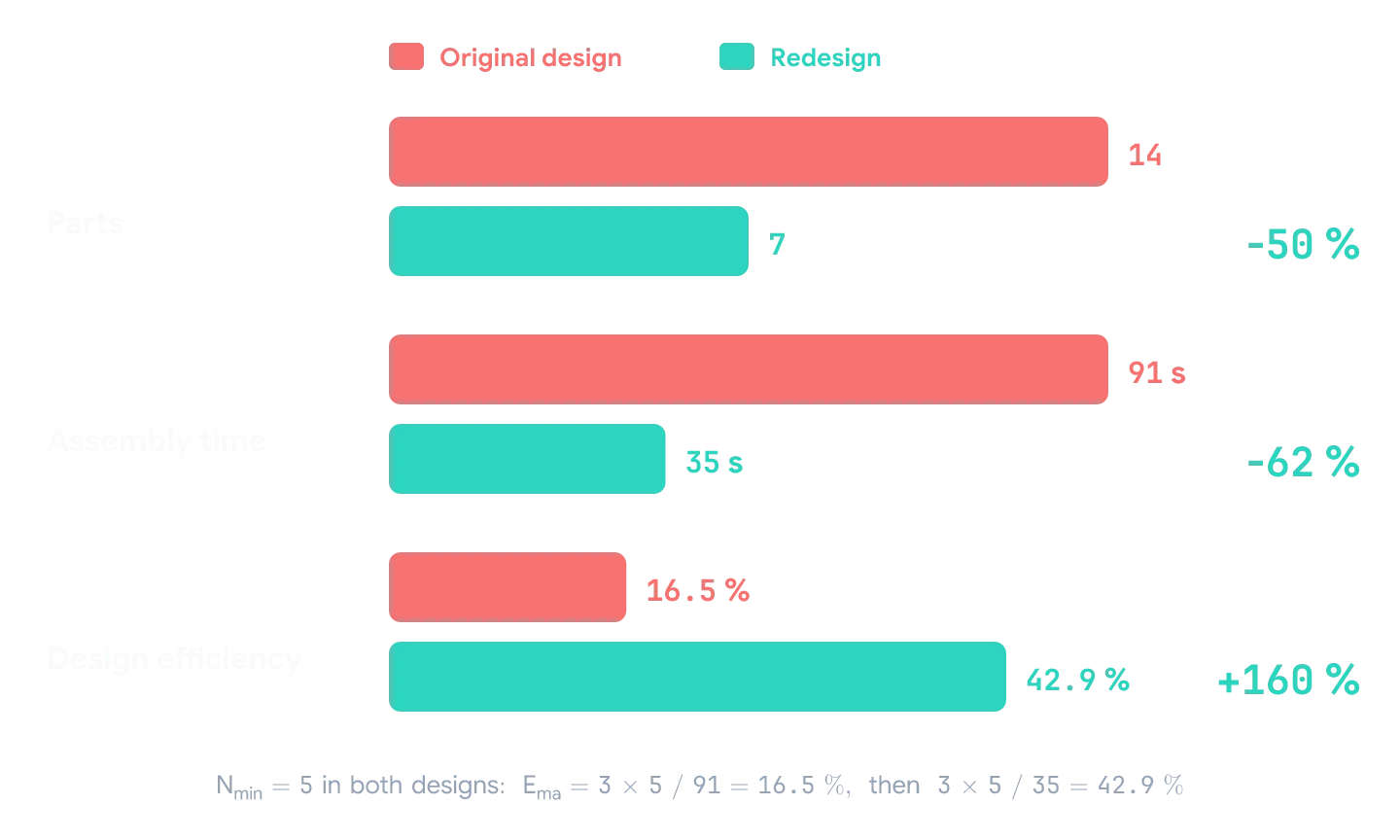
In the handbook's worked example, 14 parts and 91 s become 7 parts and 35 s, and the efficiency rises from 16.5 % to 42.9 % (illustrative numbers). The handbook builds from this idea to handling and insertion, joining, tolerance stack-up, the choice of process by volume and a complete redesign.
Choose your edition
The picker at the top of the page switches between three editions of the same material.
- Cheat Sheet: a free five-page reference with the three questions, design efficiency, handling and insertion, molded and sheet metal rules, tolerance stack-up, process choice by volume and a ten-minute review.
- Handbook: this book, six parts and five appendices, with worked examples, checklists and 25 exercises with solutions.
- Pro Handbook and Design Kit: the handbook plus a protected Excel workbook with design for assembly, design for manufacturing and DFMA kept apart, 27 printable flashcards, a guide and a weld calculator.
Who it is for
Design engineers who want a lower product cost without a lower quality, and the manufacturing, purchasing, quality and service engineers who sit in the design review.
[!NOTE] Rules of thumb in this handbook come from common practice, not from a standard: confirm them with your suppliers. The design for assembly scoring uses the handbook's own weights, not the published Boothroyd and Dewhurst tables. Worked examples are illustrative unless they say otherwise.
Related
- Sheet Metal Bend Calculator: a free tool that matches the bend allowance in the book.
- ISO 286-2 Tolerances Wall Chart: what each size grade allows.
- Mechanical Design Data Handbook: the reference tables behind the calculations.
- GD&T Handbook: geometric tolerances in depth.
Questions or a design you want reviewed? Get in touch.